
“A people without the knowledge of their past history, origin and culture is like a tree without roots.”
~Marcus Garvey
Tamil Nadu boasts of an illustrious past. However, do you know the Tamils of the Chera Dynasty produced the best steel in the world? Wootz steel remains an unsung marvel gifted by the state to the world. It goes back to 6th century BC. In the first century CE, the Roman scholar Pliny the Elder’s Natural History mentions the importation of steel from Seres, which alludes to the kingdom of Cheras. Wootz steel is a crucible steel, acclaimed for its layered wavy light-and-dark intrinsic pattern and a high carbon content.
Wootz is an anglicization of the word ‘Ukku’, the South Indian word for steel. It is believed that the origin of the term lies in the Tamil word ‘Uruku’, which means oozing of liquid.
Wootz steel can be dated back much further than the Medieval period. The production of wootz steel had been happening in India for over two millennia, before other cultures discovered it.
“Wootz was the first high-quality steel made anywhere in the world. It was more than a thousand years before steel as good was made in the West.”
– J. D. Verhoeven and A. Pendray, Muse, 1998
Having attained perfection in steel-making and resolute in keeping the technique a secret, Indians enjoyed a monopoly over the production and export of the highly sought-after metal, all around the world. Literary accounts corroborate the extensiveness of its trade- wootz steel dominated the continents of Asia, Europe and the Americas. By the late 1600s, tens of thousands of wootz ingots were traded from the Coromandel coast to Persia. Thus, it can be inferred that the wootz steel was being produced on almost an industrial scale, long before the Industrial Revolution in Europe.
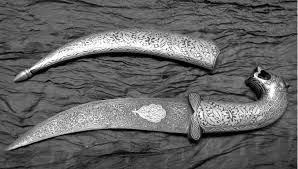
The renowned Oriental Damascus swords of the Middle Ages, so fierce that they could cut even gauze kerchiefs, were forged out of wootz steel. The Arabs took wootz steel ingots to Damascus, Syria. The blacksmiths there soon started creating intricately patterned swords out of the ingots, giving rise to a flourishing industry for weapons and armours formed out of wootz steel. Such was the splendour of the Damascus sword that Aus Hajr, an Arab poet, wrote in AD 540:
“It has a water whose wavy streaks are glistening. It is like a pond over whose surface the wind is gliding. The smith has worked out in a grain as if it were the trail of small black ants that had trekked over it while it was still soft.”
Therefore, it is no surprise that wootz steel has become synonymous with Damascus steel.
Wootz steel made for deadly weapons, second to none. Parashu was the choice of weapon of Parashurama, whose name means ‘Rama with the axe’. Parashu was usually made of wootz steel. The renowned sword of Tipu Sultan was made out of wootz steel. The valour of Tipu Sultan is known to all. It is said that he died fighting, holding the sword in his hand. His legendary swords are now part of valuable collections in Museum in England.
Wootz steel was a subject of great fascination in the scientific circles in the 19th and early 20th centuries. Benjamin Hunstman in Sheffield is credited with developing the process of crucible steel production. However, it is quite likely that he was inspired by the process of crucible steel-making in India. Michael Faraday, the father of electricity was intrigued by it. He set out on a quest to decipher the making of wootz steel along with cutler James Stodart and performed several experiments. They incorrectly concluded that aluminium oxide and silica additions contributed to the properties of the steel and their studies were published in 1820. It took decades of experimentation to decode the science behind the production of wootz steel, which finally happened during the 20th century.
What was happening back in India? The British were fearful of the prowess of the deadly Indian wootz steel swords. Following the Indian Sepoy Mutiny against the British in 1857, the British called for the destruction of all the wootz steel swords. Thus, the indigenous practice of wootz steel making met a tragic end.
Author
Bhavya Praveen Sinha
Winner of Chennai DynaCity Blogger Hunt
 Chennai DynaCity
Leave a comment